Possessive Nouns
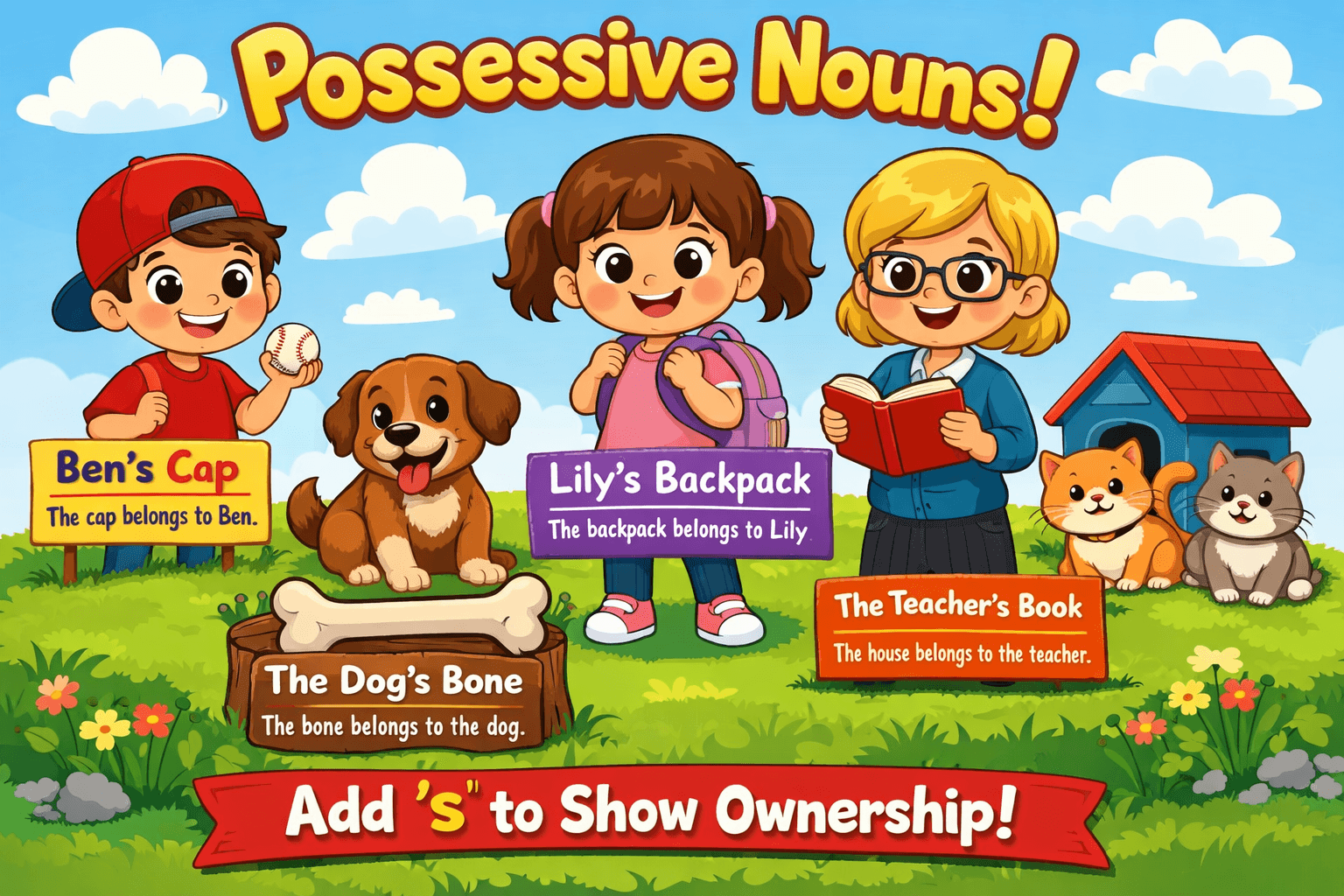
Possessive nouns are nouns that show ownership or a relationship to something by adding an apostrophe and usually an “s.”
Loading cards...
Explanation and Examples
Possessive nouns are used to indicate that something belongs to someone or something. For example, in “Sam’s toy,” the apostrophe and “s” show that the toy belongs to Sam. This makes sentences clearer and more concise.
Examples:
👉Sara’s cat (The cat that belongs to Sara)
👉The teacher’s desk (The desk that belongs to the teacher)
👉My brother’s bike (The bike that belongs to my brother)
By using possessive nouns, we can easily show ownership and make our sentences more understandable.
Types of Possessive Nouns
1. Singular Possessive Nouns
2. Plural Possessive Nouns
3. Irregular Plural Possessive Nouns
4. Compound Possessive Nouns
Singular Possessive Nouns
A singular possessive noun shows that one person, animal, or thing owns something. To form it, add ’s to the singular noun.
- Maria’s bag (The bag that belongs to Maria)
- The cat’s toy (The toy that belongs to the cat)
- The boy’s bicycle (The bicycle that belongs to the boy)
Breakdown
👉Maria’s bag: “Maria” is the singular noun, and we add an apostrophe and “s” to show that the bag belongs to Maria.
👉The cat’s toy: “Cat” is the singular noun, and we add an apostrophe and “s” to show that the toy belongs to the cat.
👉The boy’s bicycle: “Boy” is the singular noun, and we add an apostrophe and “s” to show that the bicycle belongs to the boy.
Plural Possessive Nouns
A plural possessive noun shows that more than one person, place, or thing owns something. It is formed by adding an apostrophe after the “s” of the plural noun.
- The girls’ backpacks (The backpacks that belong to the girls)
- The players’ uniforms (The uniforms that belong to the players)
- The parents’ meeting (The meeting that belongs to the parents)
Breakdown
👉The girls’ backpacks: “Girls” is the plural noun, and we add an apostrophe after the “s” to show that the backpacks belong to the girls.
👉The players’ uniforms: “Players” is the plural noun, and we add an apostrophe after the “s” to show that the uniforms belong to the players.
👉The parents’ meeting: “Parents” is the plural noun, and we add an apostrophe after the “s” to show that the meeting belongs to the parents.
Irregular Plural Possessive Nouns
An irregular plural possessive noun shows that more than one person, place, or thing owns something, but the plural form does not end in “s.” It is formed by adding an apostrophe and an “s” to the irregular plural noun.
- The children’s toys (The toys that belong to the children)
- The men’s shoes (The shoes that belong to the men)
- The women’s bags (The bags that belong to the women)
Breakdown
👉The children’s toys: “Children” is the irregular plural noun, and we add an apostrophe and “s” to show that the toys belong to the children.
👉The men’s shoes: “Men” is the irregular plural noun, and we add an apostrophe and “s” to show that the shoes belong to the men.
👉The women’s bags: “Women” is the irregular plural noun, and we add an apostrophe and “s” to show that the bags belong to the women.
Compound Possessive Nouns
A compound possessive noun shows ownership by a compound noun (a noun made up of two or more words). It is formed by adding an apostrophe and an “s” to the end of the compound noun.
- My mother-in-law’s recipe (The recipe that belongs to my mother-in-law)
- The editor-in-chief’s decision (The decision that belongs to the editor-in-chief)
- The brother-in-law’s car (The car that belongs to the brother-in-law)
Breakdown
👉My mother-in-law’s recipe: “Mother-in-law” is a compound noun, and we add an apostrophe and “s” to show that the recipe belongs to the mother-in-law.
👉The editor-in-chief’s decision: “Editor-in-chief” is a compound noun, and we add an apostrophe and “s” to show that the decision belongs to the editor-in-chief.
👉The brother-in-law’s car: “Brother-in-law” is the compound noun, and we add an apostrophe and “s” to show that the car belongs to the brother-in-law.
Exercise 1: Identify the Possessive Noun
Find the possessive noun in each sentence.
1. Ben’s ball is red.
2. The dog’s bone is on the floor.
3. The girls’ classroom is big.
4. The children’s playground is fun.
Answers:
1. Ben’s
2. dog’s
3.girls’
4. children’s
Exercise 2: Add ’s or ’
Complete the phrases.
1. James___ house is the one with the blue door.
2. The student___ backpack was left in the hallway.
3. All the teachers___ lounge was recently renovated
4. The children___ toys were scattered across the floor..
5. My brother-in-law___ car is parked outside.
Answers
1. James's house is the one with the blue door.
2. The student's backpack was left in the hallway.
3. All the teachers' lounge was recently renovated.
4. The children's toys were scattered across the floor.
5. My brother-in-law's car is parked outside
References
- https://www.98thpercentile.com/blog/possessive-nouns
- Oxford University Press – English Grammar Resources
- 98thPercentile – Possessive Nouns Guide