Basic Fractions: Understanding Halves and Thirds
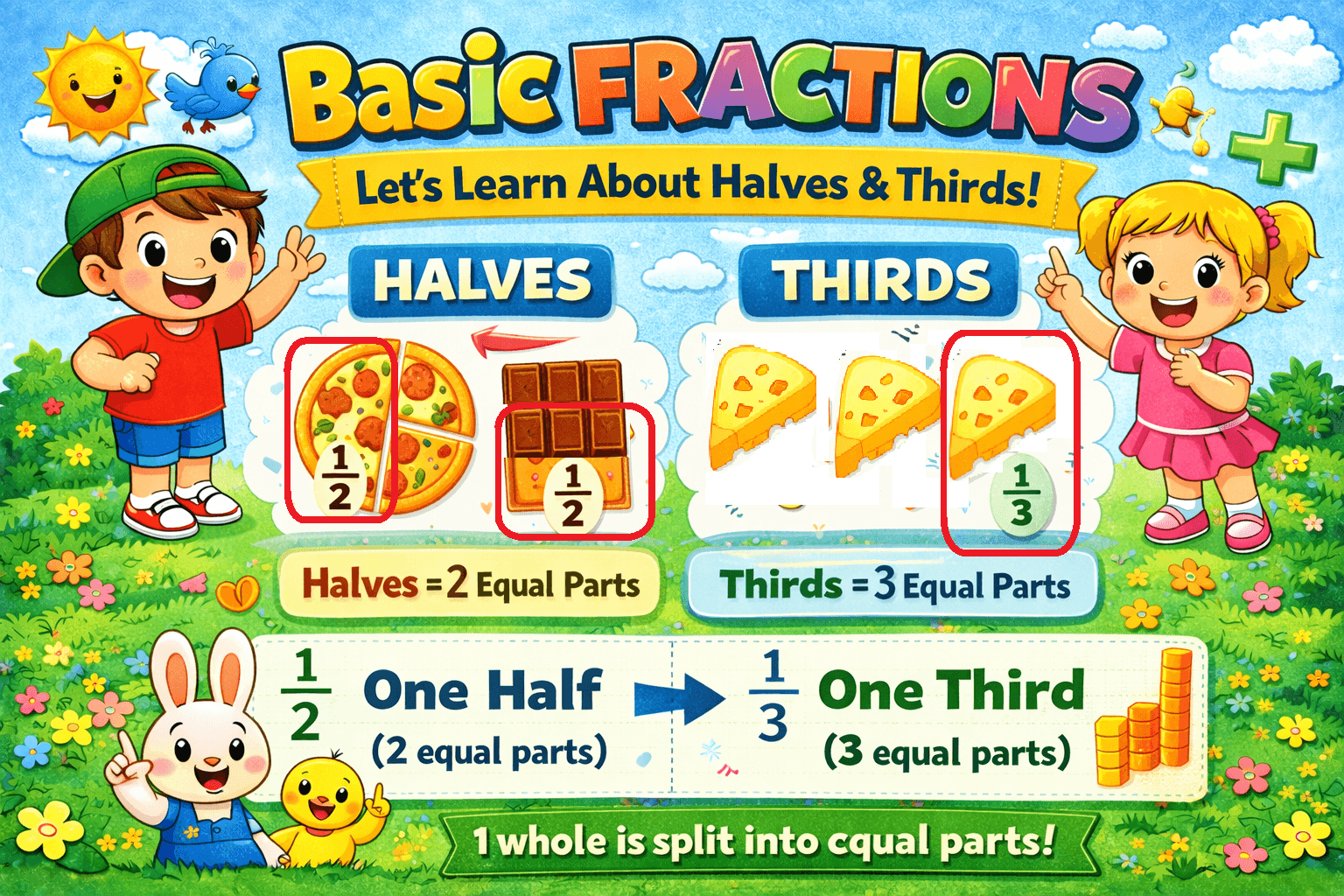
Sometimes we need to divide things into equal parts. For example, when sharing a pizza with friends or cutting a cake for family members. In mathematics, these equal parts are called fractions. Fractions help us describe parts of a whole. Learning fractions helps children understand sharing, dividing, and comparing parts.
Loading cards...
What Is a Fraction? 📚
A fraction represents a part of a whole object or group.
Example:
1/ - one half
1/3 - one third
Understanding Halves (1/2) 🔍
Example:
🍎 Apple cut into two equal parts.
Each part is 1/2 of the apple.
Example objects that can be divided into halves:
Pizza 🍕
Sandwich 🥪
Cake 🎂
If you eat one half, the other half is still left!
Understanding Thirds (1/3)
A third means something is divided into three equal parts.
Example:
🍕 Pizza divided into three slices.
Each slice is 1/3 of the pizza.
So:
3 slices = 3/3 (one whole pizza)
Let’s Practice Fractions! 🎯
3. Match the Fraction
🍎 cut into 2 equal parts. How many is each cut?
Answer: 1/2
🍕 cut into 3 equal slices. How many is each cut?
Answer: 1/3
Quick Fraction Challenge 🧠
Try answering these questions:
1.) If a sandwich is cut into 2 equal parts, what fraction is one piece?
2.) If a pizza is divided into 3 equal slices, what fraction is one slice?
3.) If you eat 1 slice out of 3 slices, what fraction did you eat?
Why Learning Fractions Is Important 🌟
Fractions help children:
● Understand sharing and dividing
● Compare parts of objects
● Prepare for advanced math concepts
The National Association for the Education of Young Children encourages using real-life examples like food and toys to help children understand fractions more easily.
Conclusion
Fractions help us describe parts of a whole. By learning about halves and thirds, children begin to understand how things can be divided into equal pieces. With fun examples like pizza, cakes, and sandwiches, fractions become easy and enjoyable to learn.
References
- National Council of Teachers of Mathematics. (2000). Principles and Standards for School Mathematics.
- National Association for the Education of Young Children. (2020). Developmentally Appropriate Practice in Early Childhood Programs.
- UNESCO. (2016). Early Childhood Care and Education Learning Framework.