Basic Graphs: Showing Information with Pictures
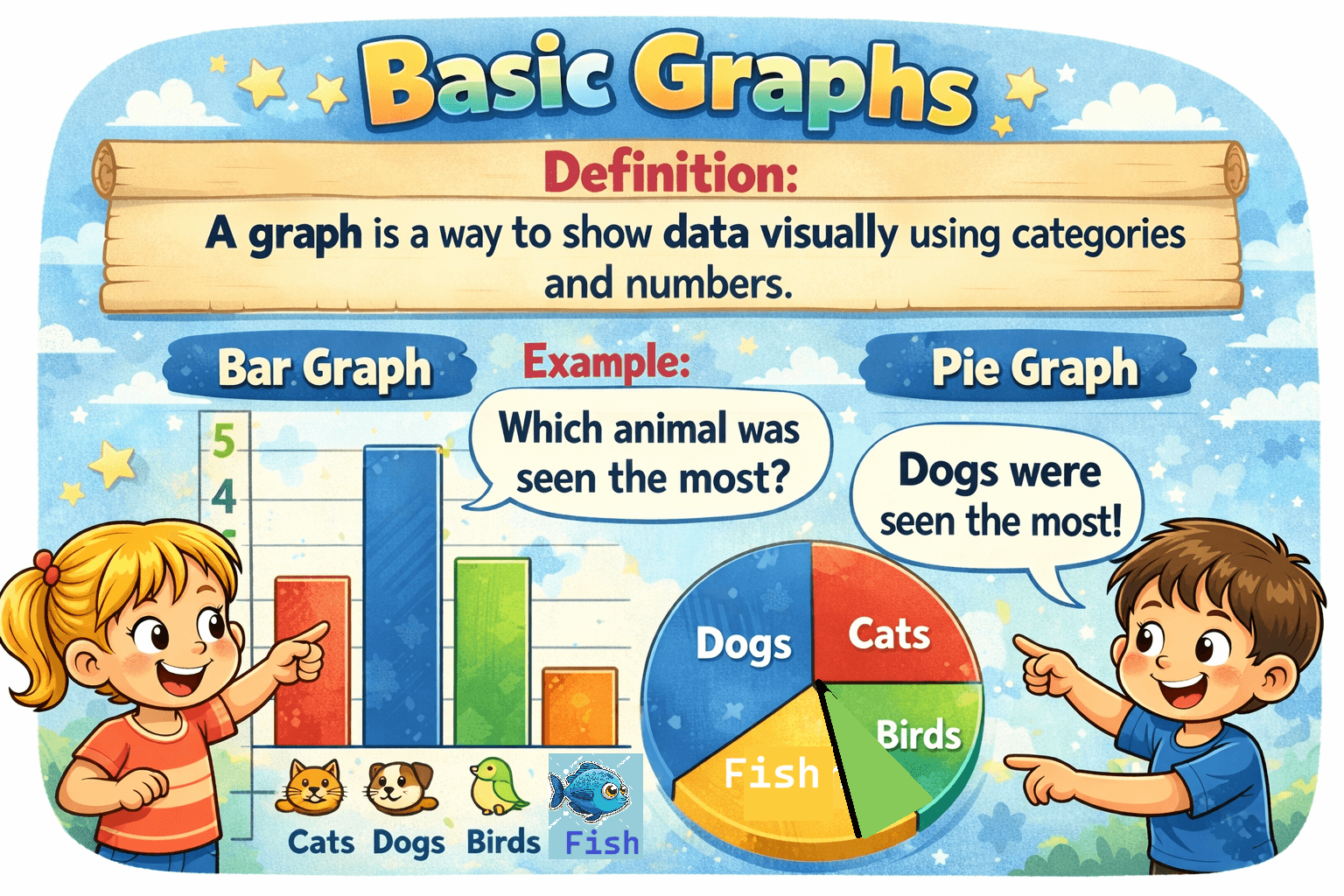
🖼️ 📊 📈✔️✨Sometimes it is easier to understand information when we see it in pictures or charts instead of just numbers. Graphs help us organize and display information in a clear and simple way. Learning about graphs helps children compare data, count items, and understand information visually.
Loading cards...
What Is a Graph? 📚
A graph is a visual way to show information or data using pictures, bars, or symbols. Graphs make it easier to see patterns and compare numbers.
For example, a teacher might create a graph to show students’ favorite fruits.
According to the National Council of Teachers of Mathematics, introducing children to graphs helps them develop data interpretation and analytical thinking skills.
Types of Basic Graphs for Kids
1. Picture Graph (Pictograph) 🖼️
A picture graph uses images or symbols to represent data.
Example: Favorite Fruit
| Fruit | Students |
|---|---|
| 🍎 | 🍎🍎🍎 |
| 🍌 | 🍌🍌 |
| 🍇 | 🍇🍇🍇🍇🍇 |
Each picture represents one student. From the graph, we can see that grapes are the most popular fruit.
2. Bar Graph 📊
A bar graph uses bars to represent numbers or quantities.
Example: Number of Books Read
Books Read by Students
The longer bar means a larger number.
3. Tally Chart ✔️
A tally chart is a simple way to count data using tally marks.
Example: Favorite Ice Cream Flavor
| Flavor | Tally | Total |
|---|---|---|
| Vanilla | |||| | 4 |
| Chocolate | ||| | 3 |
| Strawberry | ||||| | 5 |
| Mint | || | 2 |
Let’s Practice Reading Graphs! 🎯
1. Compare the Bars
If one bar shows 5 apples and another bar shows 3 apples, which one is greater?
Answer: 5 apples.
Why Learning Graphs Is Important 🌟
Graphs help children:
● Organize and understand information
● Compare numbers and data easily
● Develop critical thinking and observation skills
The National Association for the Education of Young Children encourages using visual tools like graphs to help children learn mathematical ideas more effectively.
Conclusion
Graphs are useful tools that help us understand information quickly and clearly. By learning how to read picture graphs, bar graphs, and tally charts, children can organize and compare data in fun and meaningful ways. With practice, kids can even create their own graphs to show information.
References
- National Council of Teachers of Mathematics. (2000). Principles and Standards for School Mathematics.
- National Association for the Education of Young Children. (2020). Developmentally Appropriate Practice in Early Childhood Programs.
- UNESCO. (2016). Early Childhood Care and Education Learning Framework.