Introduction to Shapes for Kids: Discovering Shapes Around Us
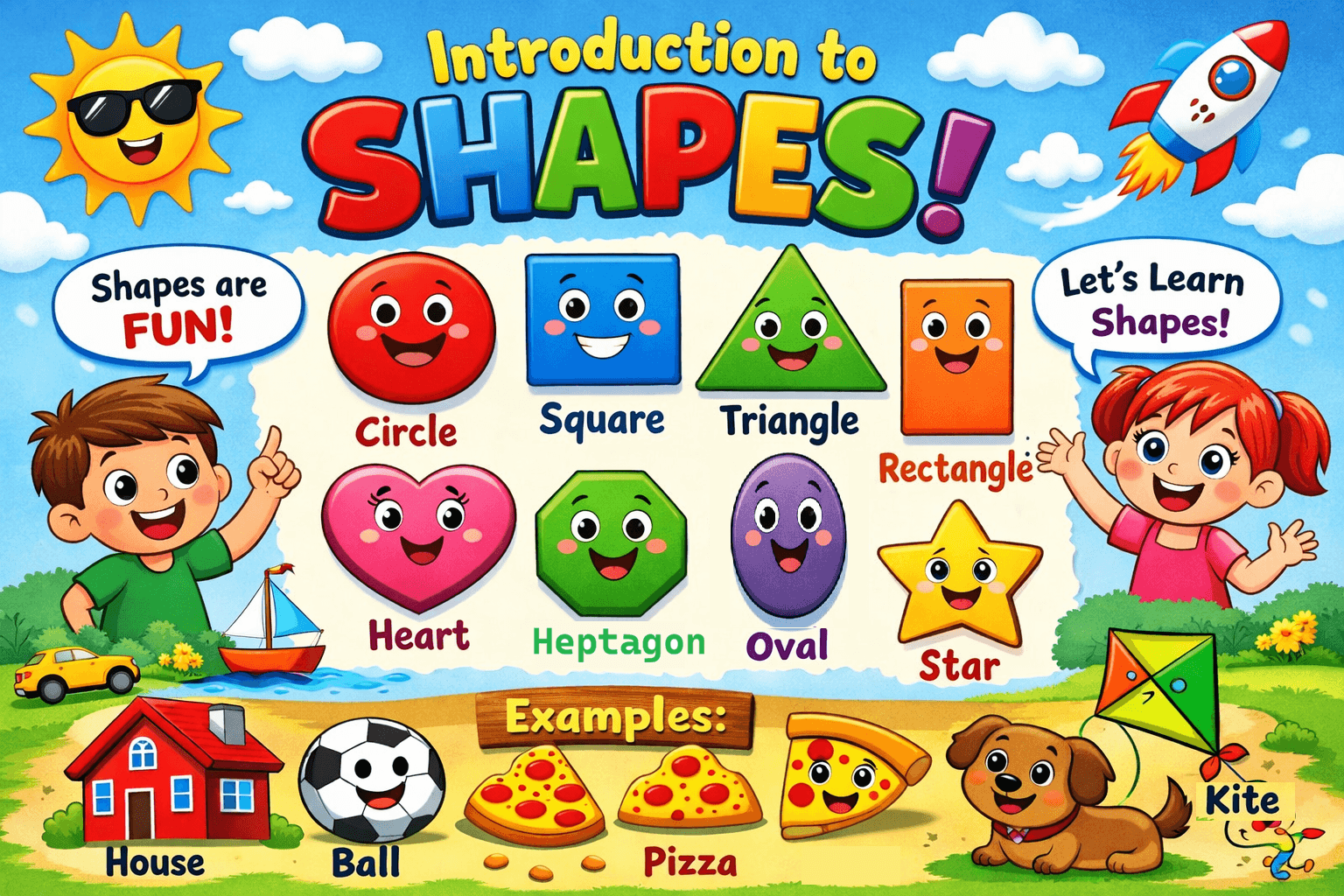
Shapes are everywhere 🔺🔵🟩! We see them in toys, buildings, food, and even in nature. Learning about shapes helps children understand the world around them and recognize patterns in everyday objects. An introduction to shapes is one of the first steps in early mathematics learning. By recognizing and naming shapes, children develop important skills in observation, problem-solving, and spatial awareness.
Loading cards...
What Are Shapes? 📚
Shapes are forms or outlines of objects. They describe how something looks and the space it occupies. Shapes can be simple and are usually identified by their sides, corners, and curves.
For young learners, common shapes include:
1. Circle
2. Square
3. Triangle
4. Rectangle
According to the National Council of Teachers of Mathematics, learning about shapes helps children develop spatial reasoning and prepares them for more advanced mathematical concepts.
Common Shapes for Kids 🔍
1. Circle 🔵
A circle is round and has no corners or sides.
Examples of circles: A clock, a coin, and a plate.
2. Square 🟩
A square has four equal sides and four corners.
Examples of squares: A window, a tile, and a box top
3. Triangle 🔺
A triangle has three sides and three corners.
Examples of triangles: A slice of pizza, a road sign and a piece of watermelon
4. Rectangle ▭
A rectangle has four sides and four corners, but its sides are not all equal.
Examples of rectangles: A door, a book and a television screen
Let’s Practice Identifying Shapes! 🎯
1. Draw the Shapes ✏️
Try drawing these shapes on paper:
a. Circle
b. Square
c. Triangle
d. Rectangle
Try a Quick Challenge! 🧠 Can you answer these?
a. Which shape has three sides?
b. Which shape is round with no corners?
c. Which shape has four equal sides?
Color them to make them fun!
Why Learning Shapes Is Important 🌟
Learning about shapes helps children:
Recognize objects in their environment
Develop visual and spatial skills
Prepare for geometry and problem-solving
The National Association for the Education of Young Children explains that hands-on activities and exploration help children better understand mathematical ideas like shapes and patterns.
Conclusion
Shapes are an exciting way for children to explore mathematics and the world around them. By identifying shapes in everyday objects, drawing them, and playing shape games, kids can develop strong observation and thinking skills. Learning shapes is the beginning of understanding geometry and many other mathematical concepts.
References
- National Council of Teachers of Mathematics. (2000). Principles and Standards for School Mathematics.
- National Association for the Education of Young Children. (2020). Developmentally Appropriate Practice in Early Childhood Programs.
- UNESCO. (2016). Early Childhood Care and Education Learning Framework.