Area and Perimeter: Measuring Shapes
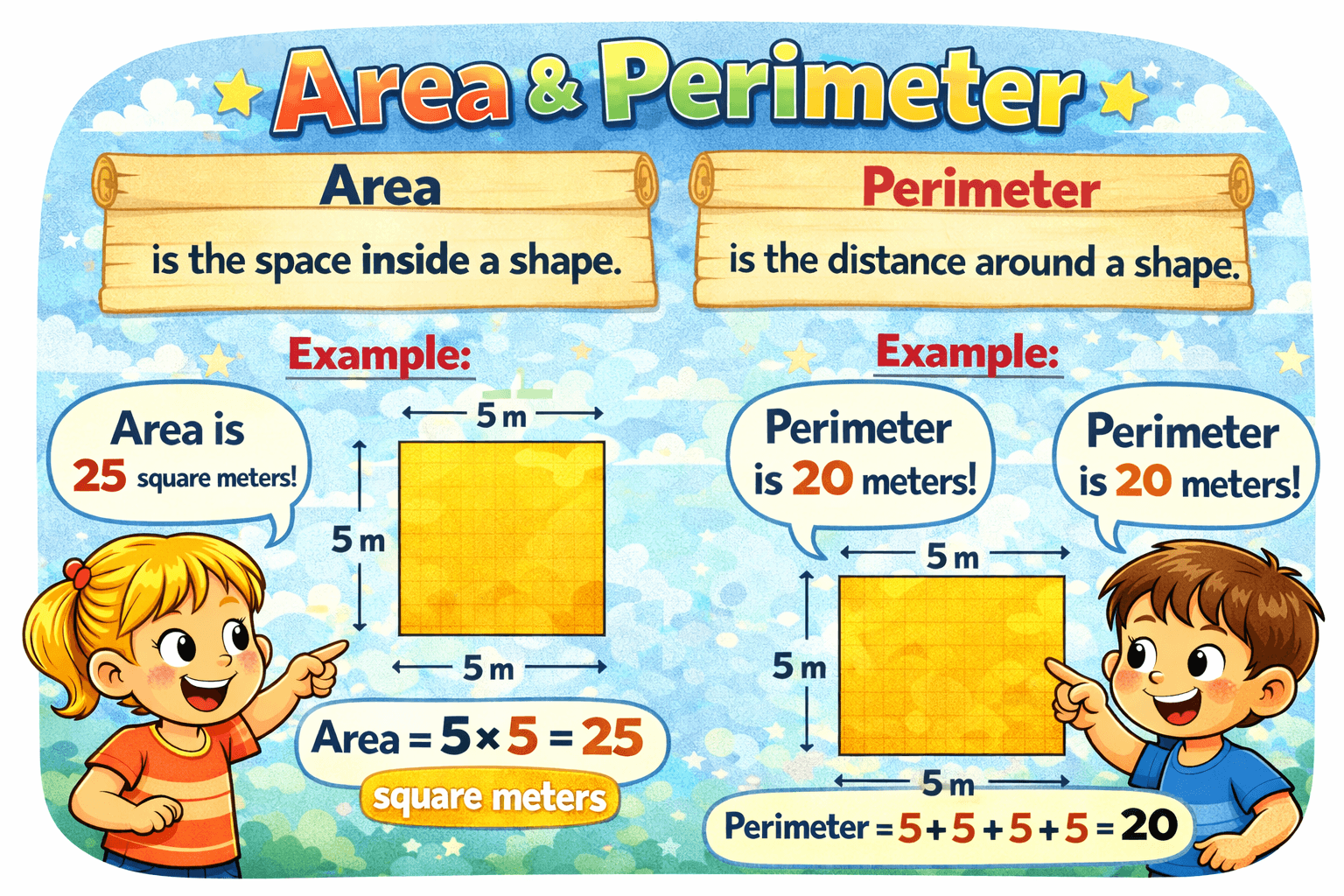
📏🔲 When we look at shapes like squares, rectangles, or playground fields, we sometimes want to know how big the space is or how long the boundary is. In math, we use area and perimeter to measure these things. Understanding area and perimeter helps children learn how to measure spaces in real life, such as gardens, rooms, and playgrounds.
Loading cards...
What Is Perimeter? 📚
The perimeter is the distance around a shape. It is found by adding the lengths of all the sides.
Example:
A rectangle has these side lengths:
● 4 meters
● 6 meters
● 4 meters
● 6 meters
Perimeter = 4 + 6 + 4 + 6
Perimeter = 20 meters
Perimeter is like walking around the edge of a playground.
What Is Area? 🔍
The area is the amount of space inside a shape. Area tells us how much surface a shape covers.
For rectangles and squares, we find the area by multiplying length by width.
A = l \times w
Where:
● A = area
● l = length
● w = width
Example:
Length = 5 meters
Width = 3 meters
Area = 5 × 3 = 15 square meters
Area of a Square
A square has four equal sides, so its area is found by multiplying one side by itself.
A = s^2
Where:
A = area
s = length of the side
Example:
Side = 4 meters
Area = 4 × 4 = 16 square meters
Area vs Perimeter
Area vs Perimeter
| Measurement | Meaning |
|---|---|
| Perimeter | Distance around the shape |
| Area | Space inside the shape |
Example: A garden fence measures the perimeter, while grass covering the garden measures the area.
Let’s Practice! 🎯
1. Find the Perimeter
A square has sides of 5 meters.
Perimeter = 5 + 5 + 5 + 5
Answer: 20 meters
2. Find the Area
A rectangle has:
Length = 6
Width = 2
Area = 6 × 2
Answer: 12 square units
3. Think About It
Which measures the space inside a playground?
Answer: Area
Why Learning Area and Perimeter Is Important 🌟
Understanding area and perimeter helps children:
● Measure spaces like rooms and playgrounds
● Plan gardens or fences
● Build strong geometry skills
The emphasizes that measurement and geometry concepts help students connect math to real-world situations.
Conclusion
Area and perimeter help us measure shapes in different ways. The perimeter tells us the distance around a shape, while the area tells us how much space is inside it. By practicing with simple shapes like squares and rectangles, children can easily understand these important math concepts.
References
- .(2000). Principles and Standards for School Mathematics.
- . (2020). Developmentally Appropriate Practice in Early Childhood Programs.
- . (2016). Early Childhood Care and Education Learning Framework.