Active and Passive Voice for Kids
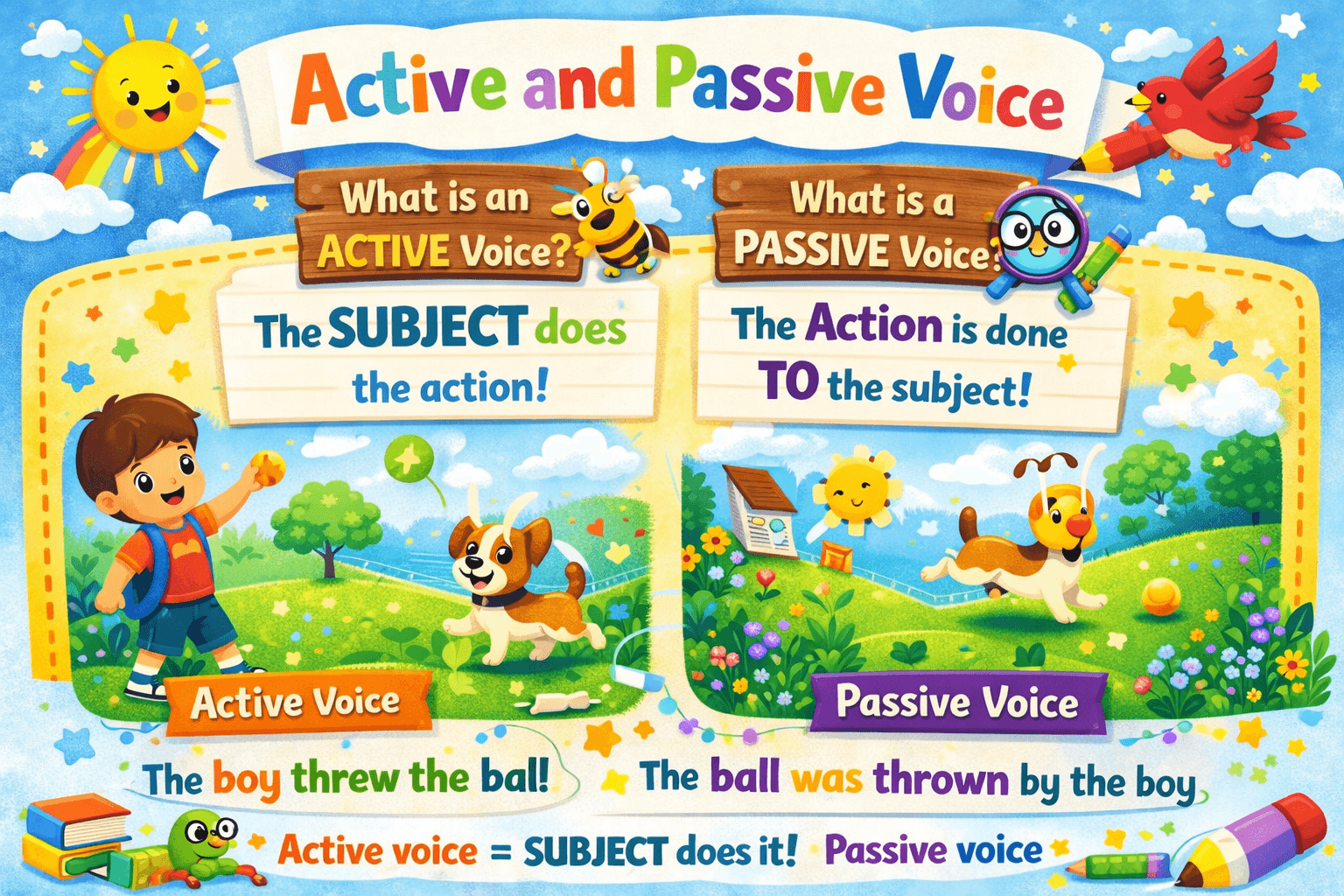
What Is Active and Passive Voice? Voice in grammar tells us whether the subject is doing the action or receiving the action.
Loading cards...
Active Voice
In active voice, the subject does the action.
Example:
The dog chased the ball.
Explanation:
The dog is doing the action of chasing.
Passive Voice
In passive voice, the subject receives the action.
Example:
The ball was chased by the dog.
Explanation:
The ball is receiving the action.
Easy Way to Remember 🧠
Active Voice: Doer → Action → Receiver
Passive Voice: Receiver → Action → Doer
Easy Way to Remember 🧠
Active Voice: Doer → Action → Receiver
Passive Voice: Receiver → Action → Doer
Example:
| Active Voice | Passive Voice |
|---|---|
| The teacher explained the lesson. | The lesson was explained by the teacher. |
| Mia baked a cake. | A cake was baked by Mia. |
| The boy kicked the ball. | The ball was kicked by the boy. |
Try It! 🎮 (Interactive Practice)
Activity 1: Identify the Voice
Is the sentence Active or Passive?
1. The chef cooked the meal.
2. The homework was finished by Liam.
3. The cat caught the mouse.
4. The song was sung by the class.
Answers
1. Active
2. Passive
3. Active
4. Passive
Activity 2: Change Active to Passive
Change these active sentences into passive sentences.
1. The artist painted the picture.
2. The kids cleaned the classroom.
3. The teacher read the story.
Possible Answers
1. The picture was painted by the artist.
2. The classroom was cleaned by the kids.
3. The story was read by the teacher.
Activity 3: Fill in the Blank
Fill in the missing words.
1. The cake _____ baked by Anna.
2. The dog _____ the stick.
3. The letter was _____ by Tom.
Possible answers: was, chased, written
More Example:
1.
Active: The boy kicked the ball.
Passive: The ball was kicked by the boy.
Explanation: The first sentence is active because the boy is doing the action.
2.
Active: The teacher read the story.
Passive: The story was read by the teacher.
Explanation: The sentence becomes passive when the story receives the action.
3.
Active: Mia wrote a letter.
Passive: A letter was written by Mia.
Explanation: In the passive sentence, the letter becomes the focus of the action.
4.
Active: The chef cooked the meal.
Passive: The meal was cooked by the chef.
Explanation: The passive voice shows the meal receiving the action of cooking.
5.
Active: The class sang a song.
Passive: A song was sung by the class.
Explanation: The passive sentence focuses on the song instead of the class.
Mini Challenge ⭐
Rewrite this sentence in passive voice:
The farmer planted the seeds.
Answer:
The seeds were planted by the farmer.
Why Do We Use Passive Voice?
We use passive voice when:
The doer is unknown
The action is more important than the doer
Example:
The window was broken.
(We don't know who broke it.)
References
- British Council – Learning English: Active and Passive Voice
- Cambridge University Press – English Grammar for Young Learners
- Oxford University Press – Oxford Learner’s Grammar