Narrative Writing for Kids
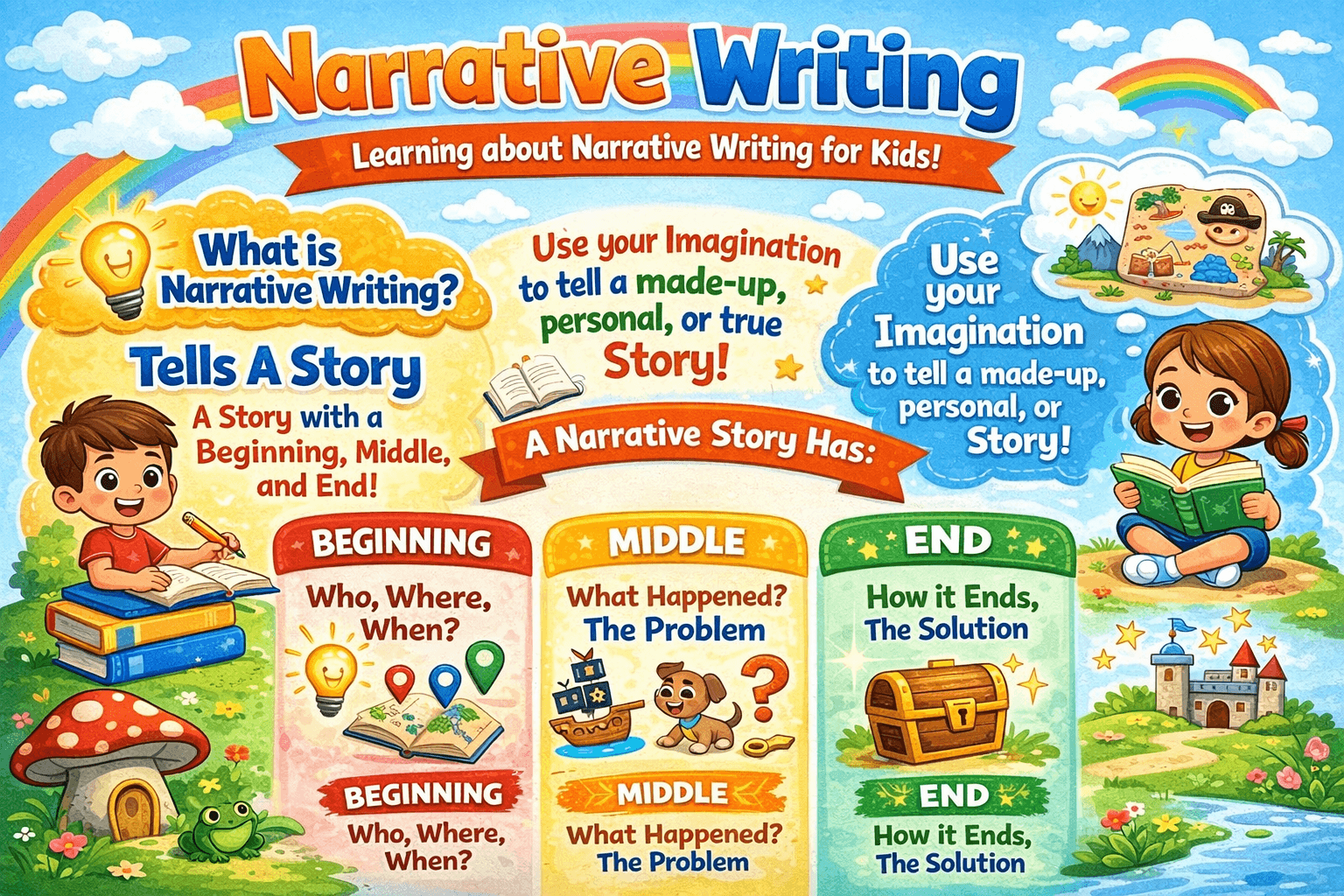
📚✨A Fun Guide to Telling Your Own Story! What is Narrative Writing? Narrative writing is a type of writing that tells a story about real or imagined events. It helps writers share experiences, adventures, and ideas in a way that readers can enjoy and understand. Stories usually have a beginning, middle, and end, and they include characters, a setting, and a problem that gets solved. Narrative writing can include: Personal stories (something that happened to you) Fiction stories (made-up adventures) Fairy tales or imaginative stories
Loading cards...
Elements of a Narrative Story
A good story usually has these parts:
1. Characters 👦🐶
Characters are the people or animals in the story.
Example:
Luna the cat wanted to explore the forest.
2. Setting 🌳🏫
The setting tells where and when the story happens.
Example:
The adventure happened in a quiet forest on a sunny morning.
3. Plot 📚
The plot is what happens in the story. It usually has:
Beginning (introduces characters and setting)
Middle (a problem or adventure happens)
End (the problem is solved)
4. Problem and Solution 🔍
Stories often include a problem that the character must solve.
Example:
Luna got lost in the forest but found her way home.
Example of Narrative Writing ✨
Example Story
One rainy afternoon, Mia found a tiny puppy under a tree. The puppy was cold and shaking. Mia wrapped it in her jacket and took it home. Soon the puppy became her best friend.
This story has:
Characters: Mia and the puppy
Setting: A rainy afternoon
Problem: The puppy was cold and alone
Solution: Mia helped the puppy
Interactive Activity 1: Finish the Story 🧠
Complete the story using your imagination!
Beginning:
One day, I discovered a mysterious box in my backyard…
Your turn!
What was inside the box?
What happened next?
How did the story end?
Interactive Activity 2: Build Your Own Story 🎲
Fill in the blanks.
Character: __________
Place (Setting): __________
Problem: __________
Solution: __________
Now write 3–5 sentences to turn your ideas into a story!
Interactive Activity 3: Beginning, Middle, End 📝
Put the story in the correct order.
The dragon helped the village by bringing rain.
A village was suffering from a long drought.
A kind dragon heard the villagers crying for help.
Correct order:
____ → ____ → ____
Tips for Writing a Great Narrative 🌟
Use descriptive words to make the story interesting.
Show how characters feel.
Add details about what characters see, hear, and feel.
Always include a clear beginning, middle, and end.
These details help readers imagine the story more clearly.
Why Narrative Writing is Important 💡
Narrative writing helps kids:
Express creativity
Improve writing skills
Share experiences and ideas
Become better storytellers
Stories are one of the oldest ways humans communicate experiences and ideas.
References
- Study.com. Narrative Writing Lesson for Kids: Structure & Examples.
- Knox Education. Narrative Writing Handbook.
- Outstanda Academy. Narrative Writing and Sensory Details.
- Wikipedia. Narration.